



ATS Troubleshooting: How to Fix a Faulty Automatic Transfer Switch
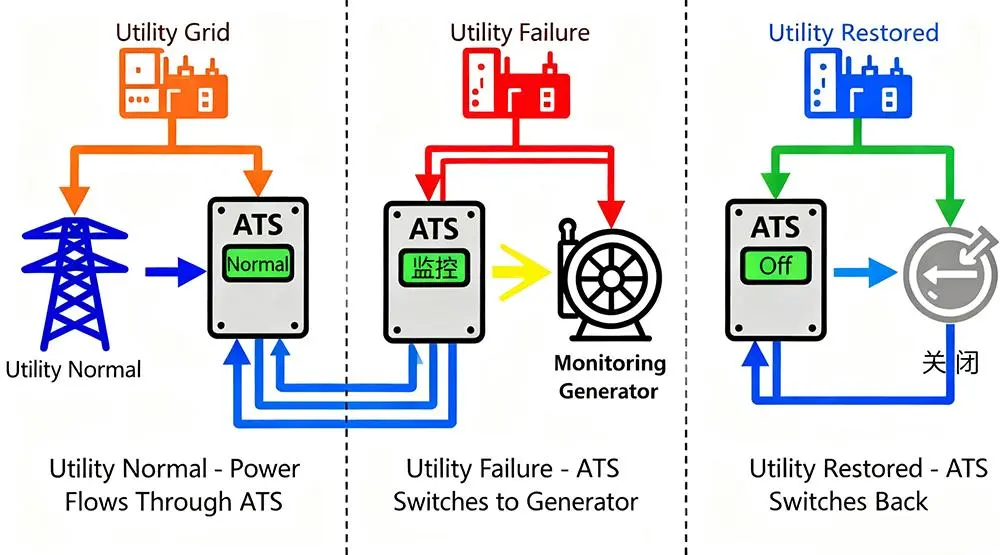
Imagine the electrical power for your critical facility as a busy highway with two lanes. One lane is the public utility grid—your everyday power source. The other lane is your diesel generator—the dedicated emergency route. The Automatic Transfer Switch (ATS) is the intelligent traffic controller at this junction. Its sole job is to monitor the grid lane and, the instant it detects a blockage (a power failure), seamlessly redirects all traffic to the generator lane within seconds. When this controller malfunctions, your entire emergency power plan grinds to a halt. A faulty ATS can mean no backup power during an outage, or worse, an unsafe connection between the generator and the grid. Understanding how to troubleshoot common ATS issues can help you restore this vital function quickly and safely.
The Critical Role of Your Automatic Transfer Switch
The ATS is the silent, vigilant brain of your backup power system. It never sleeps, constantly monitoring the voltage and frequency of the utility power. Upon a failure, it sends a start signal to your generator, waits for it to be ready, and then commands heavy-duty internal contacts to physically transfer the electrical load. When utility power returns, it safely retransfers the load and shuts down the generator. This seamless operation is non-negotiable for data centers, hospitals, and industrial processes. Therefore, a problem with your Automatic Transfer Switch directly translates to a vulnerability in your business continuity plan. Regular testing and basic troubleshooting are key to maintaining confidence in your system.
Before You Begin: Safety First
⚠️ Crucial Warning: The ATS contains live electrical parts from both the utility and generator sides. Only qualified personnel with proper training and personal protective equipment (PPE) should perform internal inspections or repairs. This guide is intended to help you identify symptoms and perform external, de-energized checks. If you are unsure, always contact a certified technician.
Common ATS Problems and Step-by-Step Troubleshooting
Here are the most frequent issues, listed from simplest to most complex, with logical steps to diagnose them.
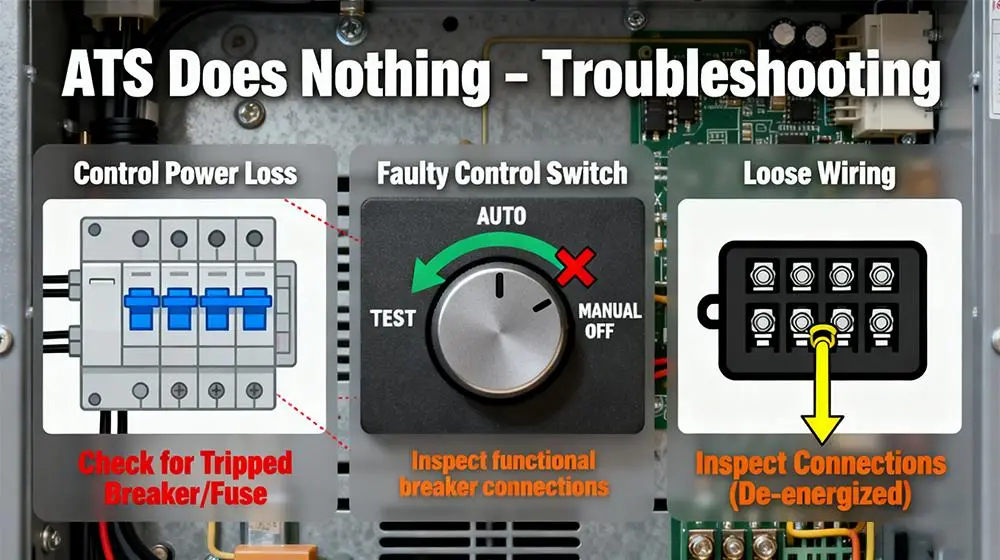
The ATS Does Nothing – No Transfer, No Generator Start
The Symptom: Utility power fails, but the ATS is silent and inactive. The generator does not attempt to start.
Potential Causes & Checks:
Control Power Loss: The ATS logic board requires a small control voltage (often 24VDC or 120VAC) to operate. Check if a dedicated control circuit breaker or fuse inside the ATS or panel has tripped.
Faulty Control Switch: Ensure the ATS is in "AUTO" mode. If it's been placed in "TEST," "MANUAL," or "OFF" position, it will not operate automatically.
Loose Wiring: With power completely off, a technician can check for loose connections on the control board terminals.
Generator Starts, But ATS Does Not Transfer the Load
The Symptom: The utility is dead, and you hear the generator start and run up to normal speed, but power is not restored to your building.
Potential Causes & Checks:
Failed Sensing: The ATS may not be sensing that the generator is ready. The generator must produce stable voltage and frequency. A technician should verify the generator output at the ATS terminals.
Time Delay Settings: Most ATS have adjustable time delays (like "engine warm-up delay") to protect the generator. Verify these settings haven't been incorrectly altered to an excessively long delay.
Mechanical Obstruction: The 0transfer mechanism itself may be jammed. Visual inspection (with all power off) might reveal an obstruction.
The ATS Transfers Erratically or Unusually
The Symptom: The ATS transfers back and forth (hunts), makes loud buzzing/arcing noises, or transfers under normal utility conditions.
Potential Causes & Checks:
Unstable Voltage: If utility power is fluctuating (brownouts) or generator power is unstable, the ATS may see this as a failure. A power quality analyzer is needed to diagnose this.
Worn or Arcing Contacts: The main electrical contacts inside the switch can wear out or pit over years of operation. This causes excessive heat, noise, and can prevent a solid connection. This requires inspection and replacement by a technician.
Faulty Voltage Sensors: The circuit boards that monitor power may be providing incorrect signals. This requires professional diagnosis.
The ATS Will Not Transfer Back to Utility Power
The Symptom: After an outage, utility power returns, but the ATS keeps the load on the generator indefinitely.
Potential Causes & Checks:
Retransfer Delay Setting: A "return delay" timer is often set to allow utility power to stabilize before switching back. Check if this setting is extremely long.
Utility Sensing Failure: The ATS may not be detecting the return of utility power on all phases. A technician must check voltage at the utility sensing terminals.
Manual Interlock: Some switches have a mechanical or programming interlock that prevents retransfer and requires a manual reset.
Preventive Maintenance is Key
Many ATS failures are predictable and preventable through a scheduled maintenance program, which should include:
Monthly Visual Inspection: Check for loose connections, overheating signs (discoloration), and dust buildup.
Functional Testing: During scheduled generator exercise, simulate a power failure and observe the entire transfer and retransfer sequence.
Infrared Thermography: An annual thermal scan can identify overheating contacts before they fail.
Mechanical Lubrication: Following manufacturer intervals for lubricating moving parts is essential.
Conclusion
Your Automatic Transfer Switch is the decisive link between a power failure and a powered facility. While some issues like mode settings or blown control fuses are simple, most troubleshooting involves working with dangerous voltages and complex controls. Knowing the common symptoms empowers you to provide clear information to a specialist, leading to a faster, safer resolution. A well-maintained ATS provides the confidence that your backup power system will perform as designed when it matters most.
For complex diagnostics, repair, or a comprehensive maintenance plan for your Automatic Transfer Switch, our team of certified power systems technicians is ready to assist. We ensure your entire backup power chain, from generator to switchgear, is reliable.
Contact us at skala@whjlmech.com for professional ATS troubleshooting and support.
References
- NFPA 110. (2022). Standard for Emergency and Standby Power Systems. National Fire Protection Association. (Chapter 6 covers transfer equipment testing).
- ASCO Power Technologies. (2023). Automatic Transfer Switch Basic Troubleshooting Guide. Emerson.
- IEEE. (2018). IEEE Standard for Automatic Transfer Switches (IEEE Std 446). Institute of Electrical and Electronics Engineers.